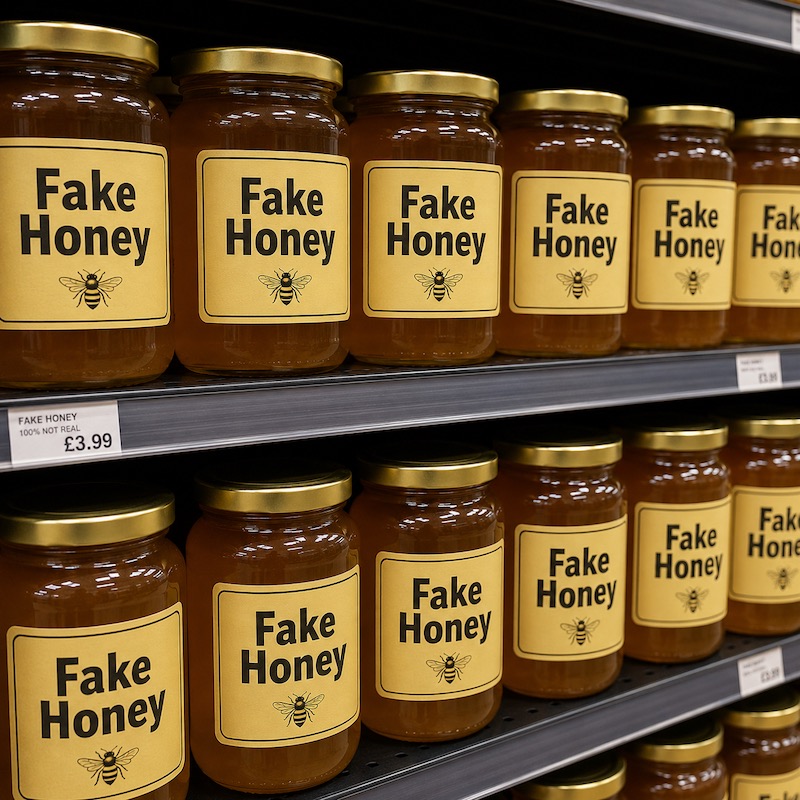
Some of the jars on the supermarket shelf are up to 90% syrup. Ten per cent honey left, if that, and the label still says honey.
That’s the scale of honey fraud my guest on this episode has spent years chasing down. Erna set up a fake honey trading company in Germany, flew to Asia posing as a buyer, walked into the syrup factories with a camera, and came back with evidence. People are now in prison because of it.
We talked about this at Apimondia, and it has got bigger since. So we did the whole thing again, top to bottom.
What this episode covers
- What honey fraud actually means, and why 90% syrup is a different problem to 2%
- How a fake German honey company got inside Chinese syrup factories
- The DNA test that can now separate real honey from adulterated honey
- Prison sentences, the European Commission, and the new labelling rules
- What you can do this week, as a beekeeper or as a shopper
Honey fraud means syrup sold as honey
Erna’s definition is simple. Honey fraud is adulterating honey, mixing syrup into it, then selling it as honey.
We’re not talking about 1% or 2% creeping in somewhere along the supply chain. Erna’s figures are 30% up to 90% syrup, with 10% honey left, sitting on a supermarket shelf under a label that says honey. Rice syrup is the most common, though plenty of other sources get used.
No beekeeper can compete with syrup on price. That’s the whole point of it. Erna started acting after watching beekeeping families, friends who make their living from bees, go bankrupt while the prices kept dropping.
Getting inside the syrup factories
This is the part of the conversation that stayed with me. Erna and a beekeeper friend registered a fake honey trading company in Germany and went looking for syrup that was, in the sellers’ own words, NMR proof. Nuclear magnetic resonance spectroscopy is one of the main tests labs use, so the syrup is engineered to slip past it.
They flew to Asia and China, visited honey factories, honey traders and the syrup plants themselves, and took photos and video from inside the buildings.
What they found was industrial. Erna describes the size of the factories as crazy, and says that once you’ve seen them, you understand the volume going into the market.
“It’s not that it’s like a small business or something. It’s something that is really flooding the market and destroying all beekeepers in the world.”
The testing has caught up
For years the fraudsters have stayed a step ahead of the labs. Erna reckons that’s changing.
Working with a laboratory in Estonia, Erna’s group spent a couple of years developing a DNA method that shows the difference between real honey and adulterated honey. That laboratory has been officially accredited for the method since April 2026, which means the results can now be used.
Other methods stack up alongside it. Proteomics can show foreign proteins or enzymes that have no business being in honey, and can show natural enzymes that are low or missing altogether. Beekeepers take samples, send them to a lab, and take the results to the authorities as evidence.
If you have ever sent a sample off and felt like nothing would come of it, that’s the bit that has shifted.
Prison sentences, and a label you can actually read
Erna is blunt about what this is. It’s a crime, and it’s organised crime, and there are already people in prison through action taken by the European Commission. Names stay out of it because the details are personal data.
The labelling has moved too. The old wording on a jar could say EU and non-EU honey, or a blend of honeys, which tells a shopper nothing at all. Under the newer European rules you get country of origin, and often a beekeeper’s name and an address you can look up.
Erna has no problem with imported honey. The problem is the mixtures that give adulteration somewhere to hide.
What to do next
A few practical things came out of the conversation.
- Taste it properly. Erna’s own rough test: real honey stays on your tongue for half an hour, sometimes longer. Fake honey hits, then vanishes. It isn’t lab evidence, but it’s a decent prompt to look harder.
- Read the label. Look for a country of origin, a beekeeper’s name, an address, something you can trace back to a person.
- Do the maths on the price. If a jar of honey costs about the same as an empty jar, ask what’s inside it. Economies of scale only stretch so far.
- Buy local. If you want to be certain, go to your local beekeeper. Ours is honey from our own hives in Wales, and you can see exactly where it came from.
- Tell your friends. Most people watching this channel are beekeepers who already know. Your neighbours don’t. Tell them, then ask them to tell someone else.