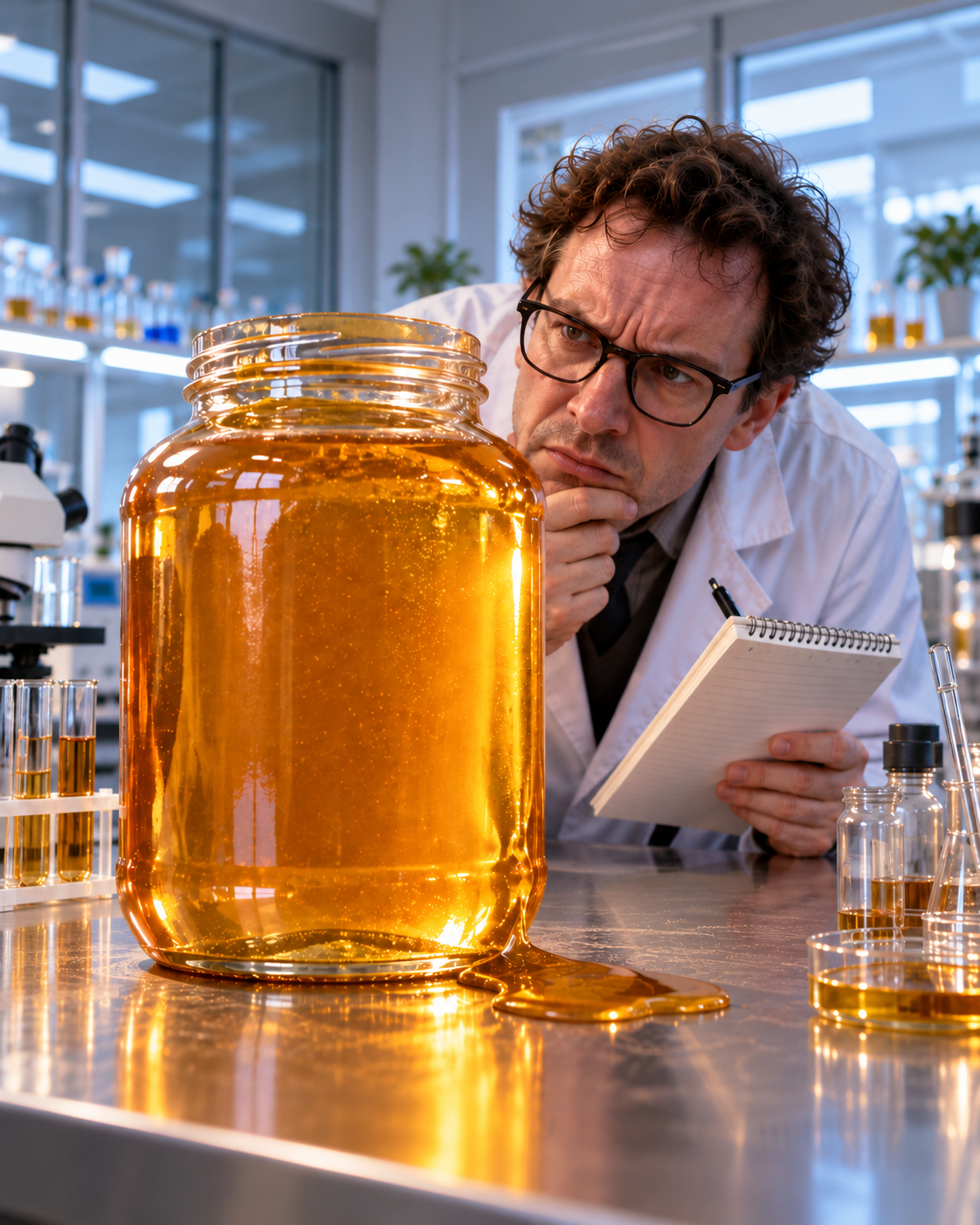
Fake honey is hurting real beekeepers, and the scale is far bigger than most people imagine.
Bernhard Heuvel says some jars sold as honey may contain between 30% and 90% syrup. His investigation took him inside factories in China, into laboratories and all the way to the European Parliament.
In this podcast, we look at how fake honey is made, how investigators are exposing it and what you can do to buy real honey with confidence.
What this episode covers
- How cheap syrup is mixed into honey and sold as the real thing
- What Bernhard found while posing as a honey trader in China
- How DNA and protein testing can help investigators build evidence
- Why fraud is driving down prices for working beekeepers
- What buyers, beekeepers and retailers can do right now
What fake honey means
Bernhard describes honey fraud as mixing syrup into honey, then selling the result as honey. Rice syrup is commonly used, although he says the true source can be hard to trace.
The quantities he describes are staggering. Bernhard says investigators have found products containing between 30% and 90% syrup. This is industrial adulteration rather than a small amount entering a batch by accident.
A beekeeper cannot produce genuine honey at the price of industrial syrup. Bernhard started acting after watching beekeeping families and friends struggle while bulk honey prices kept falling.
“When you see all your friends suffering, you start acting.”
How fake honey enters the supply chain
Bernhard wanted evidence, so he and another beekeeper created a fake German trading company. They posed as buyers looking for syrup designed to avoid detection by nuclear magnetic resonance testing.
That took them inside syrup factories, honey factories and business meetings in China. They took photographs and videos while negotiating as traders.
Bernhard says the size of those facilities showed him the true volume of the trade. Large quantities can enter international supply chains and compete directly with honey produced by real beekeepers.
Better honey testing is producing results
Older testing methods have not stopped the fraud. Bernhard believes investigators need to examine honey as a biological product, alongside chemical and physical tests.
His team worked with a laboratory in Estonia on DNA-based testing. He says the method can help distinguish genuine honey from adulterated products. The laboratory became accredited for this work in April 2026.
He also discusses proteomics, which examines the proteins and enzymes in a sample. According to Bernhard, foreign proteins, unexpected enzymes or missing natural enzymes can provide evidence that a product has been altered.
The laboratory result is only part of the job. Investigators need a documented chain of custody showing who bought the jar, where it came from and how it reached the laboratory.
Bernhard says early reports to police and authorities went nowhere. Once his team learned how to document the evidence and use the right channels, authorities began their own investigations. Products have since been removed from shelves, and cases have reached national authorities and the European Commission’s anti-fraud system.
Why fake honey hurts real beekeepers
Bernhard says bulk honey prices in Germany fell from roughly €5 to €6 per kilogram to about €1.80. Some commercial beekeepers have been left holding two years’ worth of stock because packers keep delaying purchases.
The pressure reaches beyond the honey crop. Bernhard has seen commercial operations cut from around 2,000 colonies to 200. He also says equipment manufacturers and other beekeeping businesses have closed or suffered major falls in sales.
Fewer commercial colonies can mean less pollination. In Germany, Bernhard says professional beekeepers account for only 1% of beekeepers but manage almost half the country’s colonies.
Fake honey hits beekeeper families, weakens the wider bee industry and takes money from customers who believe they are buying honey.
Can you spot fake honey?
The old “EU and non-EU honey” label told shoppers very little about where a jar came from. Bernhard welcomes moves towards clearer country-of-origin labelling, but he warns that price alone does not prove quality.
His investigations have found suspected fraud across different price points, including products sold as organic or Fairtrade. A higher price can make fraud more profitable.
Taste may offer a clue. Bernhard says genuine honey tends to leave a flavour that lingers, while syrup-heavy products can give a quick hit of sweetness that disappears. Taste is not a laboratory test, and experience matters.
If you want to see what should happen between the hive and the jar, read our guide to raw honey.
How to buy real honey with confidence
- Buy from a local beekeeper you trust and ask where the honey came from.
- Look for a country of origin, a beekeeper’s name or another detail you can trace.
- If a jar seems impossibly cheap, ask how the numbers work.
- Try different local honeys and learn how their flavours vary.
- Tell other people what is happening so they can make an informed choice.
You can explore our Welsh honey range or try our Welsh Ling Heather Honey. Our honey is raw, unpasteurised, never heated above hive temperature and fully traceable.
If this conversation has made you curious about keeping bees, 14 Day Beekeeper gives you a practical route from your first questions to confident colony management.
Watch the full fake honey investigation
The full conversation goes deeper into factory visits, laboratory testing, enforcement, labelling and what needs to change next.
Watch the fake honey podcast with Bernhard Heuvel, then share it with someone who buys honey from a supermarket.
Bernhard could not choose only one favourite honey. His final answer was the best one.
“What I like the most is real honey.”