top of page

Adam's Apiaries: Receiving My First Black Mountain Honey Nuc of Bees

Updated: Jun 28, 2024

Bee Nucs from Black Mountain Honey

Nuc of bees from Black Mountain Honey
When you receive your bee nuc, pop them on the stand and just give them a little bit of time before opening the disc.

In this blog I will be sharing my experience of receiving my first Black Mountain Honey bee nuc. Like many people, I received an overwintered bee nuc from BMH this year and I wanted to spend a little time talking through the experience.


Some of you may be very new to beekeeping so I thought it would be good to share my experience with you. As many of you will know, BMH has a very informative YouTube video series on receiving your first colony, the link for this is at the bottom off this blog. There is also a useful guide on the BMH website:


Being only a novice beekeeper, I thought that sharing my experience of receiving and taking my nuc through the first season may be of some use to you. After all, watching Laurence on a video doing it and doing it yourself for the first time can be a little different! I bought my Black Mountain Honey overwintered Nuc from the page below:


Welsh Overwintered Poly Langstroth Nucleus Colony - 2025 Delivery
Buy Now

Bee Nuc Delivery


Before the bee nuc arrives you are given plenty of notice to when you nuc of bees will be ready and sent out. The date of arrival has a degree of flexibility to it, so if your off on holiday don't worry the nuc of bees will not be sent out. Remember though, the nucs have to be signed for so you will need the day off or someone will need to be home. Its worth staying home just to see your postman's face!!


Your bees will arrive in a Payne's poly nuc, this is a perfectly acceptable home for the colony for a week or two, but not much longer than that. One thing that you will need on the day of arrival is a piece of wood or solid plastic to cover up the ventilated roof of the nuc.


When your nuc of bees arrive all that you need to do is to place them onto the hive stand, with the entrance facing the same direction as you will want the final hive and place the piece of wood over the ventilated roof.


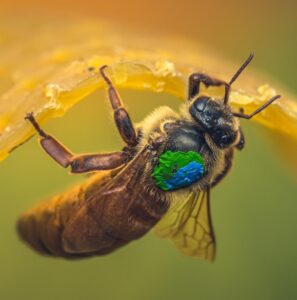
The mated f1 Buckfast queen in the bee nuc will be marked with a bright spot

Preparation


At this point just go and pop the kettle on... There are two reasons for this, one it gives the bees a little time to settle down from being jiggled about and two you can just double check that it is the correct spot for where you want the bees. Once you open them up, moving the hive can be a real pain! It can be done but it is a slow process.


Best bet, get them in the correct place first. Before you put your suit on go and find a Philips(cross head) screw driver and pop it on the top of the nuc of bees ready. Now finish your tea and pop your suit on.


With your suit and gloves on remove the couple of screws that have been put through the entrance disk on the bee nuc, then just slip the disk around to fully open and let the bees out. Just note the bees may be a little crabby, the nuc I received were, but not aggressive in any way and they soon settle down.


Bee Nuc Transfer


With some time gone by and the nuc of bees all settled in you will soon need to move the bees from the bee nuc into their full size hive. For this you will need the the rest of the frames that are required to fill a full size brood box.


The additional frames do not need to be drawn, fresh frames of foundation are fine. The lid of the bee nuc is screwed down for transport, note that they are star drive screws so on the day that the nuc arrives take a little look, so you can find what your looking for. Its a fairly standard head that comes in most DIY sets, so this shouldn't be too much of an issue.


Make sure that you have everything you need before you start to transfer your nuc of bees

Before you start make sure you have all the equipment that you require including the new hive and a feeder and some feed. You should have all your PPE on and the smoker should be lit. Just take a minute to make sure all you need is to hand. Then you can remove the screws from the roof of the bee nuc.


Its as simple as moving thIts as simple as moving them from the bee nuc to the beehiveem from one box to the other.
Its as simple as moving them from the bee nuc to the beehive

Gently move the nuc of bees to the side and place the new hive in its place. You will find that any bees that are flying will start to fly back into the new hive as they are orientated to a spot not to a box. With your smoker just give a small puff into the entrance of the nuc, only a small one there is no need to go mad!!


They really are as calm as they are made out to be. Gently pop the lid off the bee nuc and make sure you have a good look at the roof before you set it to one side you don't want to put your queen in the grass!


Sandwich the frames from the nuc of bees between fresh foundation.

Transfer Bee Nuc Frames In Order


With the frames being new in the bee nuc there was very little propolis to stick everything down so I didn't use a hive tool. I just gently lifted the frames out one at a time. If there is a bee in your way you can just gently brush them out of the way, or give a very gentle puff with the smoker.


Take your time and have a look at each frame as you transfer the frames across from the bee nuc to the beehive, keeping the frames in the order that you have removed them. The main thing you need to see as you move them across is the queen. She will be marked, hopefully you will find her in the middle of a frame, but sometimes they love to hide from you. Along with the queen you should be able to see brood in all stages and some stores.


Final Checks


Having moved all the frames across from the nuc of bees and as long as you have seen the queen and are happy that she is now in her new home, you will still have a few bees in the bee nuc. All that you need to do is to turn the bee nuc box upside down and give it one good knock onto the hive, this should dislodge the last of the bees. Make sure that you then move the old bee nuc box away from the area.


Enjoy watching your nuc of bees coming and going.

Feeding


Once you have moved all the frames over in order, add the correct number of frames to the hive to fill it up. This will differ depending on the type of hive that you have. This leaves one important job to do, feed them. Although the nuc will arrive with plenty of stores they will soon use them up! Especially this year. A pint or two of 1:1 syrup will make a huge difference.


Not only are you giving the bees food, it will stimulate the colony and the queen. This can make them believe that there is a flow on and that they need to maximize on this. The queen will therefore up her laying and the colony will draw more comb to give her the room.


It really is as simple as that. Now all you need to do is to sit back and watch your bees grow from strength to strength. Through all of BMH's video's you will hear the repeated talk about just how calm that their bees are. Well I can say that they are!


For those who aren't quite ready for a nuc of bee but are interested in learning more about beekeeping, Laurence has created a useful starter video called 'How To Start Beekeeping' which is well worth a watch:


5 Comments

Rated 0 out of 5 stars.
No ratings yet

Add a rating
Lynette Blackman
Jun 12, 2024

Great blog. I am about a month in with my first nuc, also in an anel hive. One thing I have noticed is there is zero bearding, so I assume they are keeping the temperature perfect for them with no problem.

Like

ROBERT ORR
Jun 12, 2024

What's the plastic hive?

Like
Adam Goodall
Adam Goodall
Jun 13, 2024
Replying to

I have not written a blog on that subject. But I will add it to the list. I have only started this season using the Anel hive so I haven’t overwintered in them yet. But if will make sure I write a blog in the spring to let you know how they are doing.

Like
Mountains

Subscribe to our newsletter

Get latest offers, deals and news directly to your inbox!

Discover the Buzz - Our latest blog articles!

How To Mark A Queen Bee

Marking a queen bee is one of those small jobs that makes a huge difference to your beekeeping. Once you know how to mark a queen safely and confidently, everything from finding her on a busy frame to tracking her age and performance becomes much easier. In this blog I will walk you through exactly how I mark a mated queen, the tools I use, and some simple tips to help you avoid common mistakes. If you have ever thought “I can never find my queen” or “I am too nervous about hurting her”,...

A Look Inside An Old Abandoned Wasps Nest

Explore the fascinating structure of an old abandoned wasps nest. Discover insights on wasps nest dynamics and learn how to protect your bees.

How To Light A Bee Smoker - Heat, Fuel and Cool

Discover how to light a bee smoker effectively with our step-by-step guide. Ensure your smoker stays lit for calm, safe bee inspections.

How To Scorch, Clean and Sterilise  Beehives
How To Scorch, Clean and Sterilise Beehives

Learn how to clean beehives effectively to keep your bees healthy. Discover step-by-step methods on how to clean beehives and protect your colonies.

How I Extract Honey From Honeycomb

Discover how to extract honey with ease using my methods at Black Mountain Honey. Learn how to extract honey efficiently and stress-free.

How To Make Natural Beeswax Firelighters From Old Brood Frames

Old brood frames and scrap beeswax can look like a horrible mess, but there is still a lot of value left in them. Once I have rendered out as much wax as I sensibly can, there is often a pile of darker, lower grade wax that I would never use for candles or cosmetics. Instead of throwing it away, I turn it into simple, natural firelighters. In this guide I will walk you through how I make beeswax firelighters using wood wool and recovered wax from old brood frames. This is not about fancy...

How To Render Beeswax Cappings Into Beeswax Blocks

Beeswax cappings are one of the nicest by products of extracting honey. They look and smell fantastic, they are usually much cleaner than old brood comb, and they give you some of the highest quality wax you will ever get from your bees. A lot of beekeepers scrape them off, let them pile up in a tub and never quite get around to dealing with them. That is a shame, because with a simple process you can turn those sticky cappings into clean wax blocks ready for candles, polishes or swapping in...

How I Time My Varroa Treatment Around A Cold Snap To Kill More Mites

Varroa is still the number one health threat to honey bees in the UK. You feel it in spring when colonies that looked fine in autumn come out weak, slow and virus ridden. One of the biggest improvements I have made in my own beekeeping is learning to time winter oxalic acid treatments around a natural brood break, instead of just picking a random date on the calendar. In this guide I will show you how I use the first proper cold snap as a trigger, apply a simple three week rule and then treat...

How I Light A Smoker Using My 3 Step Technique: Heat, Fuel And Cool

Discover how to light a smoker with ease using my 3-step technique: Heat, Fuel, and Cool. Master how to light a smoker confidently today!

Throwback Thursday: Eight Weeks After My Demaree Split

Explore the power of the Demaree Split in beekeeping! Discover how this method prevented swarming and boosted honey yield in just eight weeks.

Apimondia 2025 Copenhagen: Highlights, Innovations and the Road to Apimondia 2027 Dubai

Discover Apimondia 2025 highlights, innovations, and the path to Apimondia 2027 in Dubai. Join the global beekeeping community at Apimondia!

14 Day Beekeeper - Pre Launch

Join the 14 Day Beekeeper pre-launch and transform from novice to expert in just two weeks. Secure early access to 14 Day Beekeeper today!

bottom of page